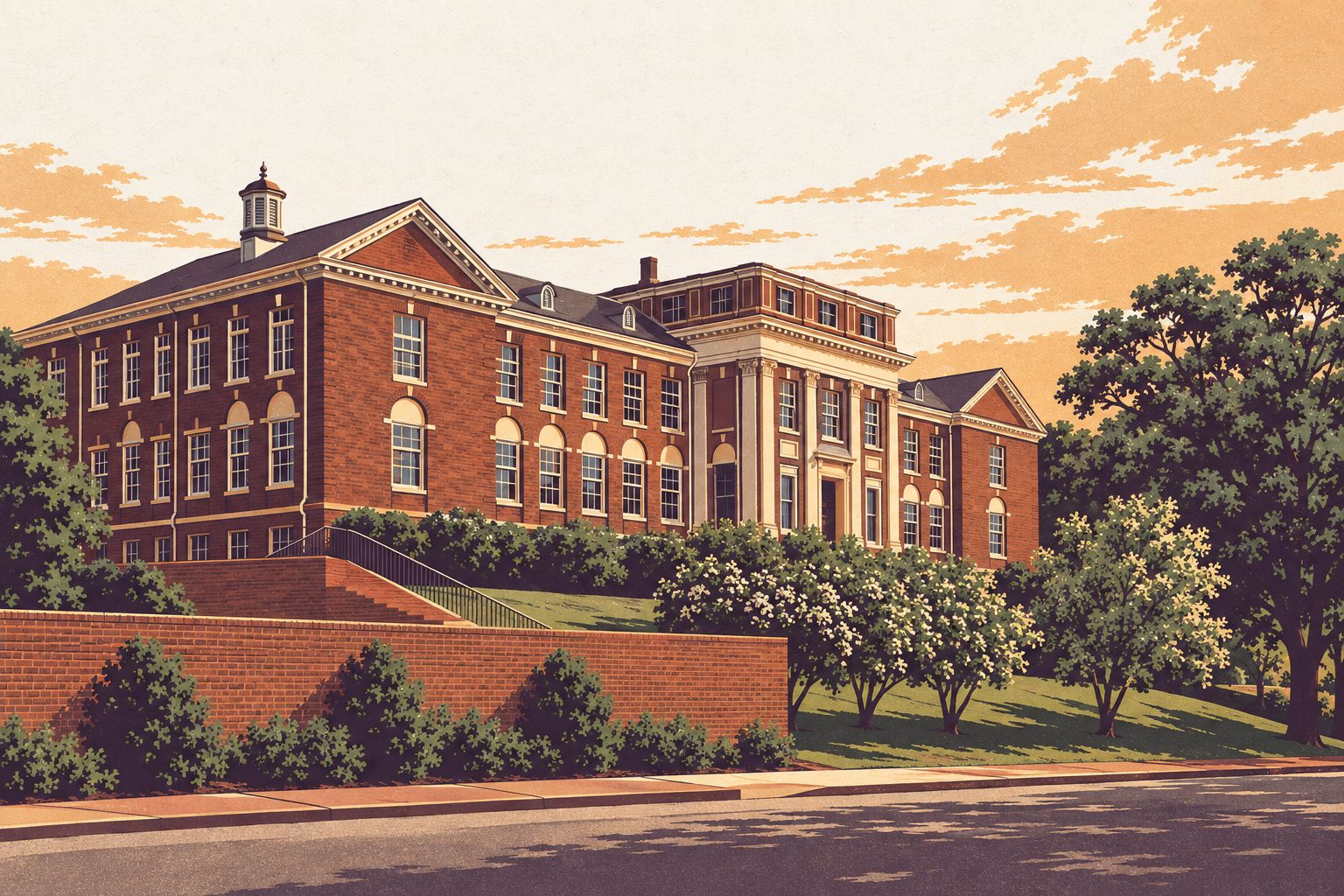
What it is like
Howard sits in northwest Washington, D.C., in the Shaw neighborhood, and people often call the campus "The Mecca." It is a private university with 10,108 undergraduates and 3,371 graduate students, with students from more than 70 countries. Most of your classmates would be Black (77% of undergraduates), and most would be women, since men make up about 27% of the undergraduate body.
This is a city campus. The Shaw-Howard U Metro station, on the Green and Yellow lines, connects you to the rest of Washington, and the admissions office points to the capital's landmarks, museums and arts venues as part of what you get by coming here. In February 2025 Howard became the only HBCU with the R1 research classification, the highest research tier in the Carnegie system.
The admission rate is 41%, and the middle half of students who reported SAT scores landed between 560 and 670 in reading and between 530 and 650 in math. About 91% of first-year students come back for a second year, and about 69% graduate. Roughly 40% of undergraduates receive Pell Grants.
History
Congress chartered Howard on March 2, 1867. The school is named for General Oliver Otis Howard, a Civil War general who was running the Freedmen's Bureau at the time and who later served as the university's president from 1869 to 1874. The idea started with members of the First Congregational Society of Washington, who wanted a seminary to train Black ministers. That plan grew into a full university, and within two years there were colleges of liberal arts and medicine.
The professional schools came early. The medical college began classes on November 9, 1868, with eight students and five faculty members. One of those teachers, Dr. Alexander Thomas Augusta, is reported to be the first African American to serve on a medical school faculty in the country. The law department opened on January 6, 1869, under Professor John Mercer Langston, and in 1872 it graduated Charlotte E. Ray, the first Black woman lawyer.
In 1926 Mordecai Wyatt Johnson became Howard's first African American president, and he led the university until 1960. Charles Hamilton Houston served as law dean from 1930 to 1935 and described a lawyer as either a social engineer or a parasite on society. Thurgood Marshall, who became the first Black justice on the U.S. Supreme Court, earned his law degree here in 1933. Founders Library, designed by architect Albert I. Cassell, was dedicated on May 25, 1939, after Congress set aside $1 million for it in 1929. Its clock tower was modeled on Independence Hall in Philadelphia, and the building has since been declared a National Historic Landmark. Since 1867 Howard has awarded more than 100,000 degrees.
Academics
Howard is made up of 14 schools and colleges and offers 140 programs of study across undergraduate, graduate and professional degrees. The data on what students actually finish shows a campus that leans toward science, public life and communication. The most common bachelor's degree is general biology, with 186 awarded in the latest count, followed by political science at 148, psychology at 132, and communication and journalism at 121. Public relations and advertising, kinesiology, marketing, computer science and finance also graduate dozens of students a year.
The graduate and professional side is large, and it shapes the whole place. The same data shows 135 law degrees, 98 medical degrees, 79 dentistry degrees and 63 pharmacy degrees in a single year. If you are thinking about medicine, law or dentistry later, you would be studying next to people already on that road, and the College of Medicine has been training doctors since 1868. The university is also home to Howard University Hospital, which opened in 1975, and the public television station WHUT.
In fiscal year 2023 Howard spent just under $85 million on research and awarded 96 doctorates, the figures behind its R1 classification in 2025. The university says it produces more on-campus African American Ph.D. recipients than any other university in the country. Its students have also won national fellowships: Howard counts five Schwarzman Scholars, five Marshall Scholars, four Rhodes Scholars, 12 Truman Scholars and more than 165 Fulbright recipients. The arts have a home too, in the Chadwick A. Boseman College of Fine Arts, named in May 2021 for the actor and Howard graduate. For anyone who loves history, the Moorland-Spingarn Research Center inside Founders Library holds one of the world's largest collections on the Black experience, and it grew from a collection Jesse E. Moorland donated in 1914.
Campus life
First-year and second-year students are required to live in university housing or university-sponsored housing, so plan on campus housing for your first two years. Charles R. Drew Hall houses 324 first-year men and is named for Dr. Charles Drew, the blood plasma pioneer who chaired Howard's surgery department.
There are more than 200 clubs, and the admissions office says over 150 employers visit campus each year to talk with students about internships and jobs. The student newspaper, The Hilltop, was founded in 1924 by Zora Neale Hurston.
The National Pan-Hellenic Council, the umbrella group for the nine historically Black fraternities and sororities, was founded at Howard in 1930, and five of those nine organizations were founded on this campus. Alpha Kappa Alpha, for one, was founded on January 15, 1908, in Howard's Miner Hall.
The Bison field 21 NCAA Division I teams, and most of them compete in the Mid-Eastern Athletic Conference (MEAC). Football plays at William H. Greene Stadium, which seats 7,086, and basketball plays in Burr Gymnasium. As of 2023, Howard was the only HBCU with competitive swimming and diving teams, and its men's soccer team won an NCAA national title in 1974. The band is the "SHOWTIME" Marching Band, and both current students and incoming freshmen are invited to contact the director of bands about joining.
Traditions
The admissions office calls it one of the most popular homecomings in the country. In 2025 Howard marked the 101st anniversary of homecoming, from October 19 to 26, under the theme "One of One." The week included Call to Chapel, the Royal Court Coronation, a Greek Step Show, the Lavender Reception for the LGBTQ+ community, a student fashion show and two days of Yardfest, including a Reunion Day for alumni. It ended with the Truth and Service football game against Morgan State at Greene Stadium.
The other date to know is the Hampton game. The football rivalry with Hampton University is known as the Battle of the Real HU. The university motto, Veritas et Utilitas, means Truth and Service.
Getting in
Howard takes first-year applications through the Common App. For students entering in fall 2027 there are three plans. Early Action and Early Decision are both due November 1, with decisions in late December; Early Action is not binding and Early Decision is. Regular Decision is due February 1, with decisions by early April. All admitted students have until May 1 to put down a deposit.
You will need your high school transcript, two letters of recommendation (one from a counselor and one from a teacher), the Common App essay and a $45 application fee. There is also one optional essay specific to Howard. SAT and ACT scores are not required for the 2027-28 cycle, and the admissions office says students who apply without scores are not at a disadvantage. File the FAFSA by your application deadline for priority consideration for aid; Howard's federal school code is 001448.
Paying for it
Howard's main merit awards for new freshmen are the Howard University Freshman Scholarships, known as HUFS. There are seven levels, from the Presidential Scholarship to the Access Scholarship, and a student can receive only one. There is no separate application: the university decides eligibility from your high school GPA and test scores if you sent them, or from your Student Aid Index for the need-based awards. HUFS can be renewed for up to eight consecutive semesters as long as you keep a FAFSA on file and meet the credit and GPA requirements written into your award contract.
Timing matters. Scholarships are awarded to admitted Early Action and Early Decision applicants who meet the requirements at the same time as their late December decisions, so applying by November 1 means you hear about money months sooner. Domestic students must file the FAFSA. Beyond HUFS, individual schools and colleges offer departmental scholarships, and donor scholarships open up once you are a continuing student.
The price a family actually pays depends heavily on aid, so before you decide anything, run your own numbers through Howard's net price calculator.
Visiting
Howard runs guided campus tours on weekdays at 10 a.m. and 2 p.m., led by student ambassadors. A tour with the information session takes about two hours, and you need to register ahead because space is limited. Tours start at the Mordecai Johnson Administration Building at 2400 6th Street NW, and there is parking along Georgia Avenue. Tours run in seasons, roughly fall, spring and summer, and pause for May commencement, so check dates before you book flights. If you cannot make a guided tour, the admissions office posts a self-guided scavenger hunt you can print and bring to campus.
Bison Preview is Howard's open house for high school seniors, transfer students and their families. In 2026 it was scheduled for Saturday, October 3, from 9 a.m. to 3 p.m., with check-in at Douglass Hall, and the Howard and Hampton football game followed at 3 p.m. at Audi Field, with tickets sold separately.
While you are on campus, stand in front of Founders Library and its Independence Hall style clock tower, home to the Moorland-Spingarn Research Center.
Who it fits
Howard fits a student who wants a big, busy, historically Black university in a major city and who plans to use that city. If you picture yourself interning in Washington, going on to medical, law or dental school, or working in politics, media or public relations, the degree data and the professional schools line up with that.
It also suits students who want a campus where Black history is part of daily life: the library, the law school that trained Thurgood Marshall, the founding site of five Divine Nine organizations, and a homecoming week that brings alumni back to campus. If you want a quiet, rural campus or a small school where everyone knows your name, this is probably not it. The student body is large and only about 27% men.
Families should also be clear eyed about cost. Scholarships for early applicants are awarded with the late December decisions, so applying by November 1 and filing the FAFSA on time matter.
Getting there from the West Coast
If you are flying in from the West Coast, the closest airport is Ronald Reagan Washington National (DCA), about 5.7 miles from campus by road. A taxi or car takes about 10 minutes. The airport has its own Metro station on the Blue and Yellow lines, and the Yellow Line also stops at Shaw-Howard U, near campus.
Washington Dulles (IAD) and Baltimore/Washington (BWI) are the other two choices, roughly 22.5 and 26 miles from Howard. Once you are in the city, the Shaw-Howard U Metro station on the Green and Yellow lines puts you a short walk from campus.
Every fact on this page, with its source (46)
- The U.S. Congress chartered Howard on March 2, 1867. Wikipedia: Howard University
- Howard is named for General Oliver Otis Howard, Civil War hero and commissioner of the Freedmen's Bureau, who served as university president from 1869 to 1874. Wikipedia: Howard University
- The idea began with members of the First Congregational Society of Washington who wanted a theological seminary for Black clergymen; it expanded to a university, and within two years had colleges of liberal arts and medicine. Wikipedia: Howard University
- The 256-acre campus, often called The Mecca, is in the Shaw neighborhood of northwest Washington, D.C. Wikipedia: Howard University
- Mordecai Wyatt Johnson was Howard's first African American president, serving from 1926 to 1960. Wikipedia: Howard University
- Howard is the founding site of the National Pan-Hellenic Council and five of the nine NPHC organizations. Wikipedia: Howard University
- The Hilltop student newspaper was founded in 1924 by Zora Neale Hurston. Wikipedia: Howard University
- Howard University Hospital opened in 1975; Howard is home to the public television station WHUT-TV. Wikipedia: Howard University
- The Chadwick A. Boseman College of Fine Arts was established in May 2021, named for the actor and alumnus. Wikipedia: Howard University
- Founders Library has been declared a National Historic Landmark. Wikipedia: Howard University
- Most of Howard's 21 NCAA Division I varsity teams compete in the Mid-Eastern Athletic Conference (MEAC). Wikipedia: Howard University
- William H. Greene Stadium (capacity 7,086) is home to football; Burr Gymnasium is the basketball arena. Wikipedia: Howard Bison
- As of 2023, Howard is the only HBCU with competitive swimming and diving teams. Wikipedia: Howard Bison
- Howard men's soccer won an NCAA national championship in 1974. Wikipedia: Howard Bison
- Howard's primary athletic rivalry is with Hampton University, known as the Real HU. Wikipedia: Howard Bison
- Howard University Law Department started on January 6, 1869, under Professor John Mercer Langston; in 1872 it graduated Charlotte E. Ray, the first Black woman lawyer. Howard University School of Law: Our History
- Charles Hamilton Houston was dean of the law school from 1930 to 1935 and described a lawyer as either a social engineer or a parasite on society. Howard University School of Law: Our History
- Thurgood Marshall, the first Black U.S. Supreme Court Justice, earned his LL.B. at Howard in 1933. Howard University School of Law: Our History
- College of Medicine classes began on November 9, 1868, with eight students and five faculty; Dr. Alexander Thomas Augusta is reportedly the first African American to serve on a medical school faculty in the country. Howard University College of Medicine: History
- Founders Library was dedicated on May 25, 1939, designed by Albert Cassell; Congress appropriated $1 million for it in 1929; its tower was borrowed from Independence Hall in Philadelphia. Founders Library: History
- The Moorland Collection was donated in 1914 by Howard trustee Jesse E. Moorland; the Moorland-Spingarn Research Center is housed in Founders Library. Founders Library: History
- Founders Library, built in 1939 by architect Albert I. Cassell, houses the Moorland-Spingarn collection, one of the world's largest catalogues of the Black experience. National Trust for Historic Preservation: Founders Library
- Since 1867 Howard has awarded more than 100,000 degrees; about 11,000 students come from over 70 countries. Howard University: History
- Howard is a private research university of 14 schools and colleges, with 140 programs of study. Howard University: About
- Howard has produced five Schwarzman Scholars, five Marshall Scholars, four Rhodes Scholars, 12 Truman Scholars and more than 165 Fulbright recipients, and produces more on-campus African American Ph.D. recipients than any other U.S. university. Howard University: About
- The university motto is Veritas et Utilitas, Truth and Service. Howard University: About
- On February 13, 2025, Howard received the R1 Carnegie Classification, the only HBCU with that designation; in fiscal year 2023 it recorded just under $85 million in research expenditures and awarded 96 doctorates. The Dig at Howard University
- Howard moved from R2 to R1 in the 2025 Carnegie Classifications and is the only HBCU with the R1 designation. Higher Ed Dive
- Howard has 200+ clubs and 21 Division I teams, over 150 employers visit campus each year, and the admissions office calls its homecoming one of the most popular in the country; D.C. offers landmarks and arts venues. Howard Office of Admission: Campus Life
- First-time-in-college and second-year students are required to live in university or university-sponsored housing. Howard Student Affairs: Apply for Housing
- Drew Hall is a residence hall for 324 freshmen men, named for Dr. Charles Drew, authority on blood plasma preservation and chair of Howard's surgery department. Howard Student Affairs: Drew Hall
- Howard's marching band is the "SHOWTIME" Marching Band; interested current university students and incoming freshmen are invited to contact the director of bands. Chadwick A. Boseman College of Fine Arts: Marching Band
- Alpha Kappa Alpha Sorority was founded on January 15, 1908, at Howard University's Miner Hall. Alpha Kappa Alpha: History
- The National Pan-Hellenic Council was founded in 1930 at Howard University. National Pan-Hellenic Council
- Howard's homecoming marked its 101st anniversary October 19 to 26, 2025, with the theme One of One, including the Truth and Service football game against Morgan State. The Washington Informer
- Homecoming 2025 events included Call to Chapel, Royal Court Coronation, the Lavender Reception, a student fashion show, the Greek Step Show, two days of Yardfest including Reunion Day, and the game at Greene Stadium against Morgan State. Howard Alumni Relations
- For fall 2027: Early Action (non-binding) and Early Decision (binding) are due November 1 with decisions in late December; Regular Decision is due February 1 with decisions by early April; deposit deadline May 1. Howard Office of Admission: First Year
- First-year applicants apply via the Common App and submit a transcript, two recommendations (counselor and teacher), the Common App essay, an optional Howard essay and a $45 fee; scholarships are awarded at the late December decision time to accepted EA and ED applicants who meet the requirements; FAFSA submitted by the application deadline gets priority consideration. Howard Office of Admission: First Year
- Howard is test-optional for the 2027-28 admission cycle and students who do not submit scores are not at a disadvantage; Howard's FAFSA school code is 001448. Howard Office of Admission: Admission Policy
- Howard University Freshman Scholarships (HUFS) have seven types from Presidential to Access; a student may receive only one; no separate application is required; eligibility uses GPA, test scores or Student Aid Index; awards renew for up to eight consecutive semesters, with credit and GPA requirements set in the individual contracts and a FAFSA on file; a FAFSA is required for domestic students; departmental scholarships exist within individual schools and colleges, and donor scholarships are for continuing students. Howard Student Financial Services
- Guided tours run Monday to Friday at 10 AM and 2 PM, led by student ambassadors, about 2 hours with the information session, registration required as capacity is limited; meeting point Mordecai Johnson Administration Building, 2400 6th Street NW; parking along Georgia Avenue; tours run in fall/winter, spring and summer seasons and pause during May for commencement; guests can print the scavenger hunt and show up to campus. Howard Office of Admission: Visit
- Bison Preview is scheduled for Saturday, October 3, 2026, 9 a.m. to 3 p.m., check-in at Douglass Hall, for high school seniors, transfer students and families; the Howard vs Hampton Battle of the Real HU game follows at 3 p.m. at Audi Field, and Bison Preview registration does not include game admission. Howard Office of Admission: Bison Preview
- Shaw-Howard U Metro station is served by the Green and Yellow lines. WMATA: Shaw-Howard U
- The Ronald Reagan Washington National Airport Metrorail station is served by the Blue and Yellow lines. WMATA: Ronald Reagan Washington National Airport
- Reagan Washington National (DCA) is 5.7 miles from Howard University by road; the taxi takes about 10 minutes. Rome2Rio
- Washington Dulles (IAD) is 22.5 miles and Baltimore (BWI) is 26 miles from Howard University. Rome2Rio